

Discover the best party entertainment for all ages, from magic shows to portable mini golf. Compare options, costs, and mixed-age games for any event.
Best Party Entertainment for All Ages: 7 Ideas That Work
Table of Contents
- Why Party Entertainment for All Ages Is Harder Than It Looks
- Party Entertainment Ideas for Adults and Kids That Share the Room
- Interactive Party Activities for All Ages: Where Everyone Gets a Turn
- Party Games for Mixed Age Groups: Matching the Game to the Guest List
- Family Party Entertainment Ideas That Scale From 10 to 100 Guests
- How to Choose Entertainment: A Simple Decision Framework
- Budget, Safety, and Weather: What to Confirm Before You Book
- Frequently Asked Questions
Last Updated: October 21, 2026
Why Party Entertainment for All Ages Is Harder Than It Looks
The best party entertainment for all ages lets a toddler, a teenager, a parent, and a grandparent participate in the same space without anyone sitting out. That sounds simple. It rarely is.
Most party planning splits guests into two camps: things kids enjoy and things adults tolerate. Entertainers pitch to one or the other, rentals get sized for one age band, and half the room ends up watching while the other half waits.
At Holes To Go, we’ve set up portable 9-hole miniature golf courses at birthday parties, corporate picnics, and family reunions, and the pattern is always the same: the events that work give every guest a role, not just a seat.
Below, we break down the party entertainment ideas that genuinely hold a mixed-age room, plus a framework for choosing between them.
Key Takeaway
The test for any entertainment option: can a 4-year-old and a 70-year-old play the same game at the same time without one of them being a spectator? If the answer is no, it’s not all-ages entertainment.
The test for any entertainment option: can a 4-year-old and a 70-year-old play the same game at the same time without one of them being a spectator? If the answer is no, it’s not all-ages entertainment.
Party Entertainment Ideas for Adults and Kids That Share the Room
The strongest party entertainment ideas for adults and kids fall into four categories: performers, interactive games, creative activities, and active play. Each handles the age mix differently, and knowing which fits your guest list saves hours of second-guessing.
Performers include magicians, clowns, balloon artists, and themed characters. They work best in 30- to 45-minute shows that pull volunteers from the audience. The catch: performers entertain the crowd rather than engage it, so once the show ends you still need something for guests to do.
Interactive games cover mini golf, giant yard games, cornhole, and treasure hunts. These scale naturally because players self-select difficulty. A young child putts from a closer spot; an adult plays the full hole.
Creative activities like craft stations and face painting give younger guests a low-energy option and parents a place to sit.
Active play includes sports challenges, water games, and dance or karaoke setups. These burn out fast, so use them as a 30-minute block rather than the whole event.
A common mistake is booking one category and expecting it to carry four hours. Successful parties pair a performer for the peak moment with a self-running activity for the rest of the time.
Interactive Party Activities for All Ages: Where Everyone Gets a Turn
Interactive party activities for all ages share one design feature: built-in turn-taking. Mini golf, giant 4-in-a-row, tumbling blocks, and cornhole all let players rotate in and out without a schedule.
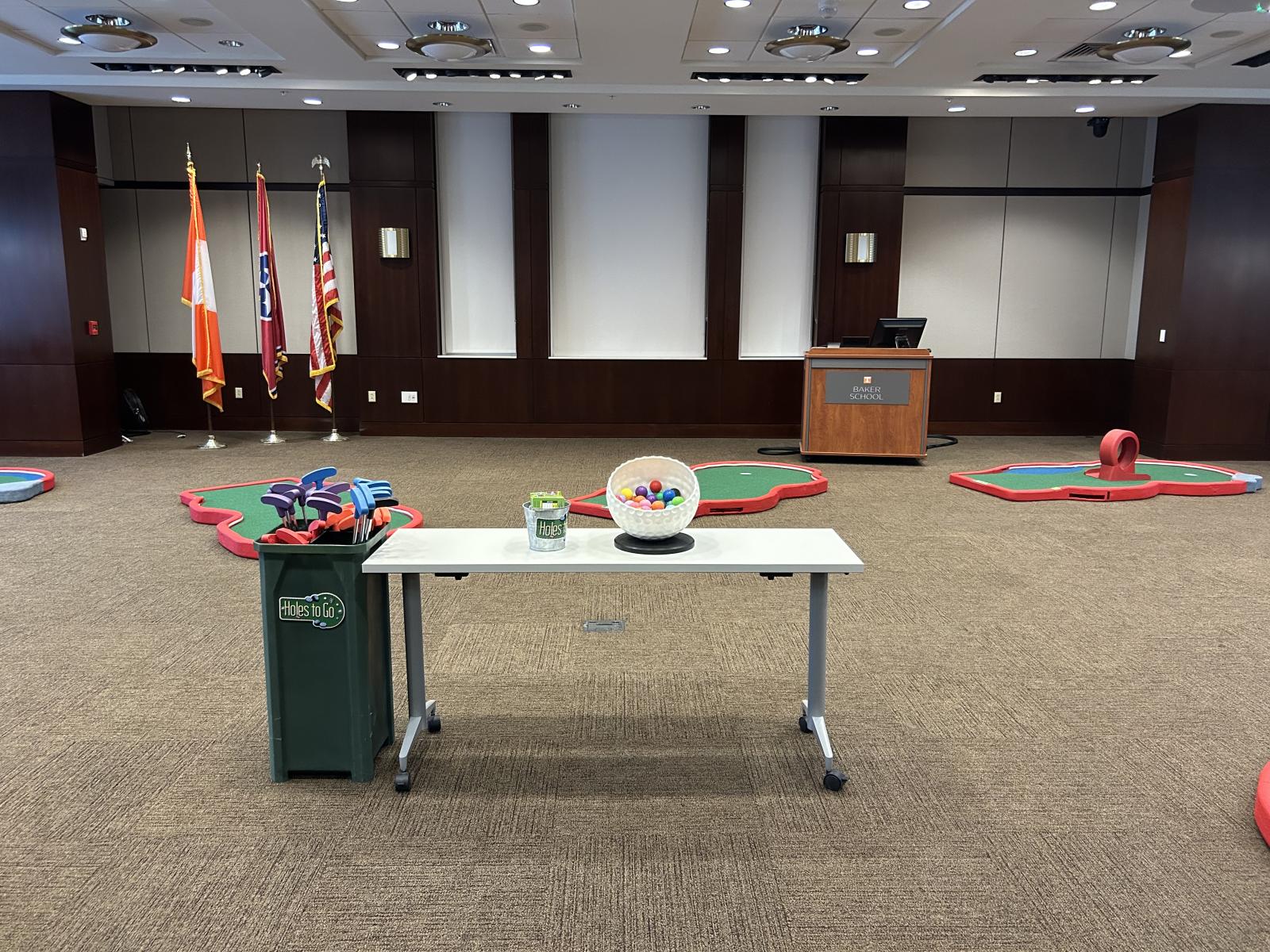
Miniature golf is the clearest example. A portable 9-hole course sets up in a backyard, driveway, or rented hall, and players move through at their own pace. Younger kids use shorter putters, older guests play the full hole, and nobody is eliminated, unlike musical chairs or dodgeball, which push kids out early and leave them watching.
Giant yard games follow the same logic: a 4-in-a-row set or tumbling blocks tower draws mixed ages because the rules take ten seconds to learn and the game resets fast.
When attention spans vary widely, rotate stations every 20 to 30 minutes so guests who tire of one activity move to the next without a formal transition.
Pro Tip
Set up the turn-heavy activity near the food and seating. Guests naturally drift toward both, and you’ll get more repeat players than if the game sits in a far corner of the yard.
Set up the turn-heavy activity near the food and seating. Guests naturally drift toward both, and you’ll get more repeat players than if the game sits in a far corner of the yard.
Party Games for Mixed Age Groups: Matching the Game to the Guest List
Party games for mixed age groups fail for one reason: mismatched physical demands. A game requiring sprinting or fine motor precision excludes either the youngest or the oldest guests.
Use this table to match the game to who’s actually coming, then apply the adaptation notes below it.
| Game Type | Works Best For | Watch Out For | Turn Style |
|---|---|---|---|
| Mini golf | Toddlers through seniors | Uneven ground on lawns | Self-paced rotation |
| Giant yard games | Ages 5 and up | Pieces scattered by toddlers | Quick reset |
| Treasure hunt | Ages 4 to 12 | Older kids finish first | Team-based, mixed ages |
| Craft stations | Ages 3 to 10 | Mess and cleanup time | Open, no turns |
| Karaoke and dancing | Teens and adults | Shy younger kids | Optional participation |
| Balloon and magic shows | All ages as audience | Passive for adults | Volunteer-driven |
Adapting for toddlers and preschoolers. Shorten the distance, use lighter equipment, and accept loose rule-following.
Adapting for school-age kids and tweens. This group wants challenge and fairness. Pair competitive kids with an adult or older sibling so the skill gap evens out, and use a handicap system: older players putt from farther back, younger from closer.
Adapting for teens. Teens disengage from anything that feels childish. Give them a role, scorekeeper, referee, or team captain, rather than forcing them into a younger kids’ game.
Adapting for older adults and guests with mobility needs. Offer seated or low-impact versions: cornhole from a chair, putting from a stable stance, craft stations at table height.
Sensory-friendly adjustments. Some guests, children and adults alike, are overwhelmed by loud music, flashing lights, strong smells, or crowds. Designate a quiet corner away from speakers, keep music at conversational volume, and avoid surprise noises like air horns or popping balloons.
If your guest list skews adult with a handful of children, lean on games that reward accuracy over speed. If it skews young, favor short rounds and frequent resets.
Pro Tip
Print a simple modification card for each game, one line for toddlers, one for teens, one for older adults. Guests self-select the version that fits them, and you avoid singling anyone out.
Print a simple modification card for each game, one line for toddlers, one for teens, one for older adults. Guests self-select the version that fits them, and you avoid singling anyone out.
Family Party Entertainment Ideas That Scale From 10 to 100 Guests
Family party entertainment ideas either scale or they don’t, and the difference comes down to throughput: how many guests can play at once, and how long each round takes.
At 10 to 20 guests, almost anything works. One activity plus food and cake fills a two-hour party. A single mini golf course, a craft table, and a few yard games cover the whole group.
At 30 to 50 guests, you need parallel stations. Two or three activities running at once keep lines short. This is where a portable course with multiple holes earns its keep: players spread across holes instead of queuing at one.
At 80 to 100 guests, throughput becomes the whole game. Corporate picnics and large family reunions need entertainment that absorbs a crowd without a bottleneck: one high-capacity anchor activity, a performer for a scheduled 30-minute block, and passive options like music and food between activities.
For a crowd of 80, expect guests to cycle through in waves rather than all at once. That’s normal, what you want to avoid is a single-activity party where everyone stands in one line.
Watch Out
Booking one entertainer for a 100-guest event and assuming everyone gets a turn is the most common scaling mistake. A magician who works a 20-person birthday party will leave most of a 100-person crowd watching from the back.
Booking one entertainer for a 100-guest event and assuming everyone gets a turn is the most common scaling mistake. A magician who works a 20-person birthday party will leave most of a 100-person crowd watching from the back.
How to Choose Entertainment: A Simple Decision Framework
Choosing party entertainment comes down to five questions. Answer them in order and the shortlist writes itself.
- What’s the age spread? If guests span more than a decade, prioritize self-paced games over performances.
- How many guests can play at once? Divide your guest count by the activity’s capacity. If the number is over three, you need a second station.
- Indoor or outdoor? Confirm the activity works in both, or have a covered backup plan.
- How long is the event? Under two hours, one anchor activity is enough. Over three hours, plan two or three.
- Who’s doing setup and cleanup? Full-service delivery removes this from your plate. Self-managed rentals add an hour or two of labor on both ends.
Run your shortlist through those five questions and most options eliminate themselves. A bounce house fails question one for mixed-age crowds and question three if rain is possible. A magic show fails question two at large events unless paired with something else.
Start with the anchor activity and build around it. Guests remember the thing they did, not the thing they watched.
Budget, Safety, and Weather: What to Confirm Before You Book
Three details decide whether a booking goes smoothly: what’s included, how the provider handles safety and cleanliness, and what happens if the weather turns. Here are the questions to ask and the trade-offs to weigh.
Budget. Pricing for party entertainment depends on the activity, guest count, date, and delivery distance, so ask for a quote rather than assuming a rate.
These are planning ranges, not quotes. When comparing quotes, check what’s bundled, setup, teardown, equipment, and staffing often separate a low quote from a complete one, and a cheap rental that leaves you hauling equipment can cost more in time than it saves.
Safety and cleanliness. Ask every provider how equipment is cleaned between events and what age ranges each item suits. For inflatables and climbing equipment, ask about supervision requirements and weight limits; for golf-style games, whether putters come in child sizes.
Weather. Outdoor plans need a rain contingency. Confirm the provider’s rescheduling policy in writing before you pay, and ask whether the setup works indoors if you need to move it.
Space. Measure before you book. A 9-hole portable course needs a defined footprint, and your backyard may be smaller than the photos suggest. Ask the provider for space requirements and share your dimensions.
Pro Tip
Photograph your setup space and send it to the provider before booking. A quick photo of the yard or hall answers the space question faster than a phone call and prevents day-of surprises.
Photograph your setup space and send it to the provider before booking. A quick photo of the yard or hall answers the space question faster than a phone call and prevents day-of surprises.
Watch Out
Never book an outdoor attraction without a written rain policy. Verbal promises are the most common source of day-of disputes, and a provider who won’t put the policy in writing is a red flag.
Never book an outdoor attraction without a written rain policy. Verbal promises are the most common source of day-of disputes, and a provider who won’t put the policy in writing is a red flag.
Frequently Asked Questions
What are the best party entertainment ideas for all ages?
The strongest options let toddlers, teens, adults, and seniors participate at the same time rather than splitting the room. Portable mini golf, giant lawn games, karaoke, and craft stations all work because each person can join at their own comfort level. Performers like magicians work best when they include audience participation and keep jokes layered so adults enjoy them too. The key is choosing entertainment that rewards participation instead of athletic skill, since that keeps grandparents and young kids on equal footing.
How do you keep guests of different ages entertained at a party?
Set up two or three activity zones instead of one main event. A quiet craft table, an active game area, and a food and conversation spot give guests permission to move between them as they like. Schedule any timed entertainment, such as a magic show or karaoke hour, in the middle of the party so late arrivals and early leavers still catch it. Also assign a host or helper to each zone so nobody is left standing alone wondering what to do next.
What party games for mixed age groups actually work?
Games with simple rules and adjustable difficulty work best. Giant 4-in-a-row, cornhole, tumbling blocks, and mini golf all let a 6-year-old and a 70-year-old compete on the same field. Avoid games built on speed, running, or physical contact, since those favor younger guests and sideline older ones. Team-based games where pairs mix ages also help, because a grandparent can coach a child through a round and both stay involved.
How long should party entertainment last?
Most mixed-age parties work best with 60 to 90 minutes of structured entertainment, followed by open play and food. Performers typically run 30 to 45 minute sets, which holds attention without exhausting younger kids. Open-ended activities like mini golf or giant games can stay set up for the whole event so guests rotate in and out. If you are booking a full-service attraction, confirm setup and teardown time so the entertainment window matches your actual party hours.
Planning entertainment for a mixed-age crowd means choosing activity over spectacle. Holes To Go delivers a portable 9-hole miniature golf course to your location with full setup and teardown, putters sized for kids and adults, and giant games like 4-in-a-row, tumbling blocks, and cornhole to fill out the lineup. It works indoors or outdoors, which keeps your rain plan simple. Get started with Holes To Go and give every guest a turn at the course.