
Compare mini golf and bounce houses for your event. Learn space needs, age suitability, costs, and which works best for your party or corporate event.
Mini Golf vs. Bounce Houses: Which Entertains Better
Table of Contents
- Mini Golf Versus Bounce Houses: Key Differences at a Glance
- Mini Golf Rental for Parties: What You Get
- Bounce House Rental for Parties: What You Get
- Portable Mini Golf Setup Requirements and Space
- Age Ranges, Participation, and Guest Throughput
- Cost, Setup Time, and Weather Considerations
- Portable Mini Golf Course Rental: The Better Choice for Your Event
- Conclusion
- Frequently Asked Questions
Last Updated: October 14, 2026
Mini Golf Versus Bounce Houses: Key Differences at a Glance
Planning a birthday party, corporate event, or family gathering? Mini golf versus bounce houses is a common decision that depends on your space, budget, and guests.
Mini golf keeps guests engaged for extended periods across all age ranges, while bounce houses deliver high-energy fun in shorter bursts for younger children.
At Holes To Go, we’ve spent 25 years helping event organizers choose. Most assume bounce houses are the automatic choice because they’re cheaper and familiar, but once you understand what each delivers, the decision becomes clearer.
Mini Golf Rental for Parties: What You Get
A mini golf course rental includes a 9-hole course delivered to your location, all equipment, and full setup and teardown.
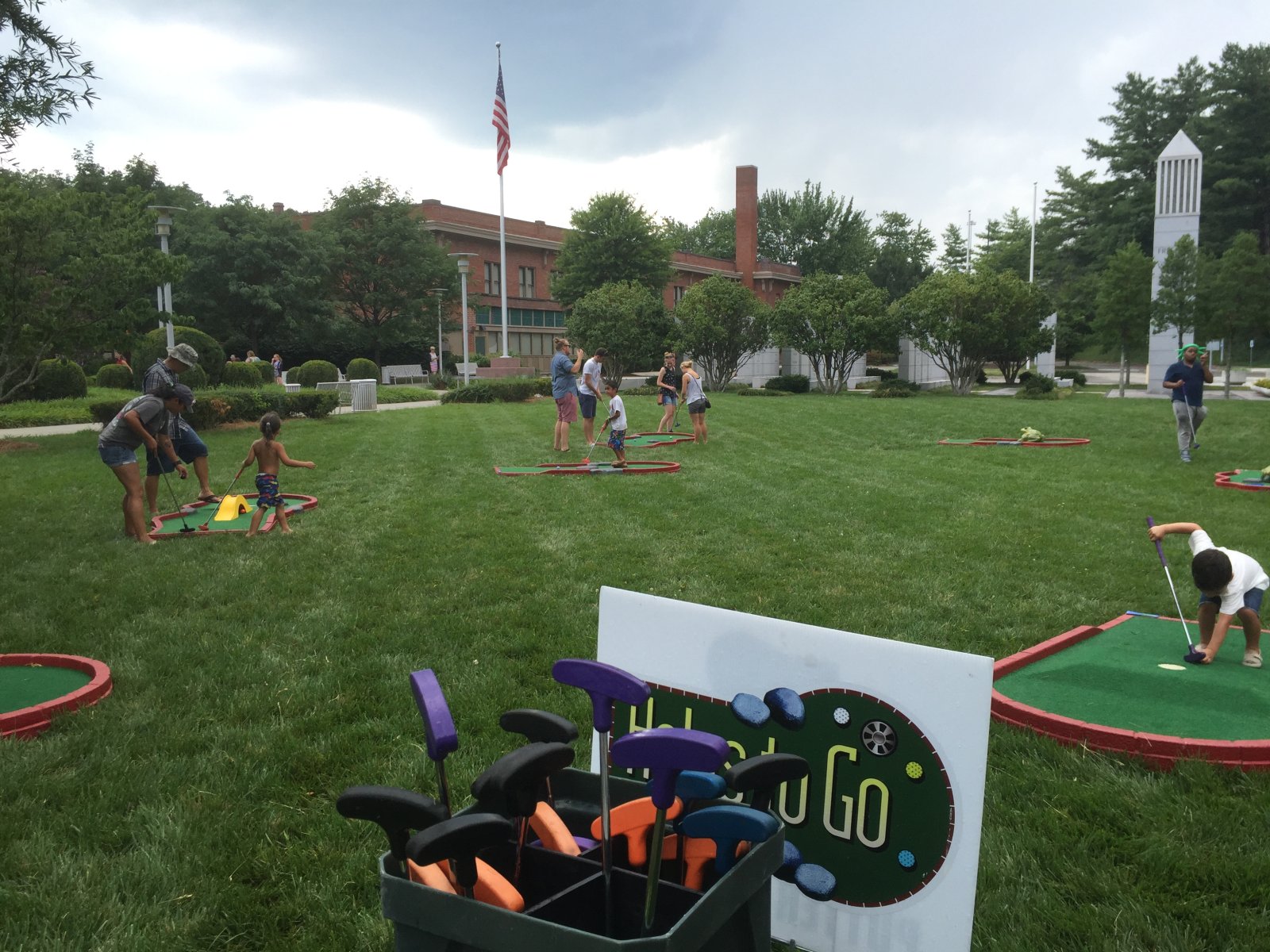
Children and adults playing on a portable mini golf course outdoors while considering mini golf versus bounce houses.
The course features obstacles, hills, and challenges that make each hole unique, with real putters and colored balls scaled for all skill levels. Mini golf keeps people engaged for 30-60 minutes per round.
What makes mini golf different is inclusivity: toddlers play with child-sized putters, seniors enjoy the low-impact activity, and adults compete seriously, everyone participates at once rather than waiting in line. This is especially valuable for mixed-age events like family reunions or corporate team-building days.
Add-on games like 4-in-a-row, tumbling blocks, and cornhole extend engagement, and the setup works indoors or outdoors.
Pro TipMini golf creates natural conversation opportunities. While guests wait for their turn to putt, they’re standing together, joking about the difficulty, celebrating good shots. This social element is what separates it from passive entertainment.
Bounce House Rental for Parties: What You Get
A bounce house rental for parties appeals to kids roughly ages 3-12, with peak engagement in the 5-8 range.
Bounce houses deliver immediate, high-energy fun with no skill required, and the rental fee is typically lower.
The limitation is duration and participation: most children bounce for 10-20 minutes before losing interest, teenagers feel it’s beneath them, and adults don’t participate, leaving some guests entertained while others watch.
Weather is a major factor: many bounce houses are outdoor-only or need covered space, rain cancels the event, and wind or cooler months diminish the appeal.
Watch OutBounce houses work best for younger children at dedicated kids’ parties. At mixed-age events, family reunions, or corporate functions, they leave significant portions of your guest list without entertainment.
Portable Mini Golf Setup Requirements and Space
Portable mini golf setup requirements are more flexible than most people assume.
A 9-hole mini golf course requires roughly 1,500-2,000 square feet of relatively flat space, smaller than most backyards, and can be set up indoors on a gym floor, basement, or warehouse, or outdoors on grass, concrete, or asphalt.
Setup runs 45-60 minutes for a full course, with similar takedown time, handled by the rental team. Power isn’t required.
Bounce houses need less total space but more clearance: a typical unit occupies 300-400 square feet and needs 10+ feet overhead and around all sides. They’re outdoor-focused or require warehouse-scale indoor space, with faster 15-20 minute setup.
The real difference: mini golf adapts to existing venue layouts; bounce houses demand specific conditions.
|
Consideration |
Mini Golf |
Bounce House |
|---|---|---|
|
Space needed |
1,500-2,000 sq ft |
300-400 sq ft |
|
Surface type |
Grass, concrete, indoor |
Flat, level outdoor or covered |
|
Setup time |
45-60 minutes |
15-20 minutes |
|
Power required |
Minimal (optional) |
Yes, for inflation |
|
Weather dependent |
No |
Yes, significantly |
|
Venue flexibility |
High (indoor/outdoor) |
Limited (mostly outdoor) |
Age Ranges, Participation, and Guest Throughput
Age compatibility, supervision load, and guest throughput differ dramatically, and few rental listings explain them side by side.
Mini golf: ages 2 to 90, one shared activity. Toddlers play with assistance, kids compete seriously, teens and adults enjoy genuine strategy, and seniors appreciate the low-impact pace.
Throughput math: a 9-hole course with 9 parallel stations hosts roughly 18-45 players at any moment (2-5 per station). Over a 2-3 hour event, that supports 40-80 unique guests.
Throughput math: with a 6-10 jumper cap and a 10-20 minute engagement window, a single bounce house cycles 15-25 children per hour.
Supervision and safety, side by side
- Mini golf supervision. One adult can typically oversee a full 9-hole course because players are spread across stations and moving at walking pace. The main risks are minor: a swung putter near another player’s ankles, a ball leaving the putting surface. Standard practice is to space groups by one hole and remind players to wait for the group ahead.
- Bounce house supervision. The Consumer Product Safety Commission and inflatable manufacturers recommend active, constant adult supervision, not a glance from the patio (Don’t Get Swept Away; CPSC Reminds Consumers to Be Grounded in Safety When Using Bounce…). Best practice is one dedicated adult at the entrance enforcing: no shoes, no glasses or jewelry, no flips, no pushing, one-at-a-time on the slide or climb, and immediate exit if the unit loses air or shifts.
Age suitability at a glance
|
Guest age |
Mini golf |
Bounce house |
|---|---|---|
|
Under 3 |
With adult help and child putter |
Usually not permitted |
|
3-5 |
Plays with assistance |
Peak appeal |
|
6-8 |
Plays independently |
Peak appeal |
|
9-12 |
Competitive |
Interest drops off |
|
Teens |
Competitive |
Rarely participates |
|
Adults |
Participates |
Watches |
|
Seniors |
Low-impact, welcome |
Watches |
What this means for your guest list
If every guest is between 5 and 8, a bounce house is simple and effective. The moment your guest list spans more than one age band, the math flips: mini golf’s parallel-station layout means a 4-year-old, a 14-year-old, and a 74-year-old can all play at once.
The participation model is the real differentiator. Mini golf creates an activity where everyone plays together, with light supervision. Bounce houses create a scenario where a capped number of young children play under close one-to-one supervision while everyone else watches.
Cost, Setup Time, and Weather Considerations
Bounce houses appear cheaper at first glance, but the sticker price is only one line of the total cost.
What actually drives the price
Bounce house rental pricing is driven by:
- Unit size and style (basic open bounce vs. combo with slide or obstacle course)
- Rental duration (usually a flat block of 4-8 hours or a full day)
- Delivery distance from the operator
- Seasonal demand (summer weekends and graduation season run higher)
- Whether the operator requires a generator, attendant, or overnight hold
Mini golf rental pricing is driven by:
- Number of holes (9-hole courses are standard; 18-hole setups double the footprint)
- Number of putters and balls requested (enough for your peak group size, not total guest count)
- Delivery distance and site access (stairs, elevators, and long carries add labor)
- Rental duration and whether the course stays up for multiple days
- Add-on games bundled with the course
Because both are quoted per event, the honest way to compare is cost per engaged guest-hour, not cost per rental.
The value math
Run the numbers on a 3-hour event with 40 guests:
- A bounce house cycling 15-25 children per hour with a 10-20 minute engagement window delivers roughly 30-75 child-hours of activity, only for ages 3-12.
- A 9-hole mini golf course running 2-5 players per station delivers continuous activity for the full 3 hours, for every age.
Dividing the rental fee by engaged guest-hours narrows the gap sharply, and for mixed-age events, mini golf frequently comes out ahead per guest even though the headline price is higher.
Setup and takedown
Setup time favors bounce houses: 15-30 minutes versus 45-60 minutes for a full 9-hole course. Takedown is comparable, and setup is handled by the rental crew, not you.
Weather: the hidden line item
This is where bounce houses carry a cost that never appears on the quote.
- Rain. Most inflatable rental agreements include a weather clause: if it rains, the operator may cancel, and depending on the contract you get a refund, a credit, or nothing. Either way, your event loses its entertainment.
- Wind. Inflatables have posted maximum wind ratings, commonly 15-25 mph. Above that, the unit must be deflated for safety, and stakes or sandbags are required.
- Heat and cold. Vinyl surfaces get hot in direct summer sun, and cold weather reduces appeal and material flexibility.
Mini golf has none of these constraints. A portable course operates indoors or outdoors on grass, concrete, or asphalt. Rain moves it inside, wind is irrelevant, and cold doesn’t stop play. For an event booked months in advance, that reliability has real dollar value.
When comparing quotes, ask each operator three questions: (1) What is your weather cancellation policy, and is the deposit refundable? (2) What is the posted wind rating on the inflatable, and who is responsible for anchoring? (3) Does the price include delivery, setup, takedown, and any required attendant? The answers often change which option is actually cheaper.
Total cost checklist
|
Cost factor |
Mini golf |
Bounce house |
|---|---|---|
|
Headline rental fee |
Higher |
Lower |
|
Delivery included? |
Varies by operator |
Varies by operator |
|
Setup/takedown labor |
Included |
Included |
|
Power/generator |
Not required |
Required for inflation |
|
Attendant required |
No |
Recommended or required |
|
Weather cancellation risk |
Low |
High |
|
Engaged guest-hours delivered |
High, all ages |
Lower, ages 3-12 |
|
Cost per engaged guest-hour |
Often competitive or better |
Often higher than it looks |
The investment in mini golf is higher on the invoice, but the return, in guest participation, event reliability, and hours of engagement, justifies it. Holes To Go handles delivery, setup, operation guidance, and takedown.
Portable Mini Golf Course Rental: The Better Choice for Your Event
For most event types, portable mini golf course rental delivers superior value.
First, inclusivity: mini golf entertains every age simultaneously, so you’re not managing separate tracks for kids versus adults.
Second, engagement depth. Mini golf keeps guests occupied for extended periods, while bounce houses deliver quick bursts.
Third, reliability. Mini golf works indoors and outdoors in any weather, so the event happens as scheduled.
Fourth, flexibility. A 9-hole course adapts to various venue sizes and shapes, while bounce houses demand specific conditions.
Finally, value perception. Guests remember mini golf as a unique, thoughtful entertainment choice. Bounce houses are familiar and expected.
The investment is higher, but the return in guest satisfaction and participation justifies it. Holes To Go handles all logistics.
Conclusion
Mini golf versus bounce houses isn’t really about fun, both are entertaining. It’s about inclusivity, reliability, and value. Mini golf entertains all ages simultaneously, operates in any weather, and keeps guests engaged for hours.
For birthday parties with mixed ages, corporate events, family reunions, and special occasions, mini golf is the stronger choice, it makes your event memorable and ensures every guest feels included.
Holes To Go delivers a complete 9-hole portable course with full setup, teardown, and equipment for all ages. We handle the logistics so you focus on your guests.
Ready to elevate your event? Book Now with Holes To Go and give your guests an entertainment experience they’ll actually remember.
Frequently Asked Questions
Which is better for a party: mini golf or a bounce house?
It depends on your guests and event goals. Mini golf works best for mixed-age groups, longer engagement periods, and outdoor or covered spaces. Bounce houses suit younger children (ages 3-10), require less skill, and keep kids physically active for shorter bursts. Mini golf encourages friendly competition and family interaction, while bounce houses offer pure physical play. For corporate events or multi-generational parties, mini golf typically provides more inclusive entertainment.
How much space do you need for a portable mini golf course?
A 9-hole mini golf course requires roughly 1,500-2,000 square feet of relatively flat space. Bounce houses vary by size but often need 15 feet by 15 feet to 20 feet by 20 feet. Before booking any portable mini golf course rental, confirm your venue dimensions and surface type with the rental company. Indoor spaces work well if ceilings are at least 8 feet high. Uneven terrain, slopes, or tight corners reduce usable space.
What age is appropriate for mini golf?
Mini golf is suitable for ages 3 and up, though younger children benefit from assistance. Most venues provide child-sized putters and simplified rules. Toddlers (ages 2-4) enjoy the experience with adult help, while kids ages 5 and older can play independently. Adults and seniors enjoy mini golf equally, making it the only rental option that truly spans all ages at a single event. Bounce houses typically max out at age 10-12, while mini golf has no upper age limit.
What should you consider before renting a bounce house?
Check age and weight limits, as most bounce houses suit children under 12 and under 250 pounds total capacity. Verify your yard or venue has 20 feet by 20 feet of level, obstacle-free space. Confirm weather conditions—most bounce houses cannot operate in rain or high winds. Ask about supervision requirements; children typically need constant adult monitoring. Confirm setup and takedown times, which often take 30-45 minutes each. Verify the rental company’s sanitation and safety certification practices between events.